
Welcome to WordPress. This is your first post. Edit or delete it, then start writing!
Blog
-
Minimum Wage in India: Employer Compliance Guide 2026

Stay 100% compliant with Serve HR The rules around minimum wage in India are simple in principle but often messy in execution. For employers, the challenge is not just knowing the rate — it is keeping payroll aligned with state-wise minimum wages, role classifications, statutory records, and changing notifications.
For HR teams, founders, and payroll managers, a small mistake in minimum wage compliance can quickly become an employee dispute, an inspection issue, or a labour-law notice. That is why understanding minimum wage rules for employers is essential for everyday labour law compliance India.
In this article, we break down what minimum wage means, who must comply, how payroll teams should manage it, where employers usually go wrong, and what practical steps help maintain employee wage compliance across India.
What is Minimum Wage in India?
Minimum wage is the legally prescribed lowest wage an employer can pay a worker for a specific category of work. In India, wage rates are typically notified by the appropriate government based on:
- the type of work
- the skill level of the employee
- the location or zone
- the industry or scheduled employment
- in some cases, cost of living and market conditions
Historically, this was governed under the Minimum Wages Act, 1948. Today, wage regulation is part of the broader Code on Wages, though state notifications and enforcement practices continue to play a major role in day-to-day compliance.
Why it matters
Minimum wage is not a policy suggestion. It is a legal floor. If an employee is paid below the applicable rate, the employer may face wage arrears, compliance notices, and claims for underpayment.
Who Must Comply with Minimum Wage Rules?
Any employer paying workers in a category covered by wage notifications should check the applicable wage rate.
This includes:
- manufacturing companies
- retail and trading businesses
- IT and IT-enabled service firms
- logistics and warehousing units
- security agencies
- facility management companies
- startups with staff on payroll
- contractor-led workforce setups
Important point for employers
Even if you outsource part of your workforce through a contractor, the principal employer still has compliance risk if wages are not paid correctly. This is especially important in HR compliance India and vendor management.
Workers often covered
- helpers
- operators
- office staff in certain scheduled employments
- housekeeping staff
- security guards
- drivers
- technicians
- shop floor workers
- contract labour
How Minimum Wage Is Determined in India
There is no single national minimum wage that applies to every employee across every state.
Instead, rates may vary by:
- state
- skill category: unskilled, semi-skilled, skilled, highly skilled
- sector
- area classification: city, urban, rural, or zone-based area
- revisions announced by the government
This is why state-wise minimum wages must be reviewed before finalising payroll.
Example
A company may pay an office assistant in Mumbai differently from a similar role in a smaller district because the applicable notified wage rate can vary by region and scheduled employment.
Minimum wage compliance checklist
- Check applicable state notification
- Match employee category and skill level
- Review salary structure every revision cycle
- Keep wage registers and payslips updated
- Pay at least the notified minimum wage
- Correct contractor wage slips and vendor documentation
- Reconcile payroll before monthly processing
State-Wise Minimum Wages: Why Location Matters
One of the biggest mistakes companies make is assuming one payroll structure works for all locations. In reality, state-wise minimum wages can differ significantly.
Employers should watch for:
- state-specific notifications
- zone-wise revisions
- industry-specific wage categories
- periodic updates from labour departments
If your business operates in multiple states, the payroll team should not depend on a single salary template. A role that is compliant in one state may be underpaid in another.
What records businesses should typically maintain
- wage registers
- attendance records
- salary slips
- contractor wage records
- proof of payment
- employee classification documents
- compliance declarations for audits or inspections
In payroll practice, this means:
- salaries are processed according to the notified wage rate
- deductions are lawful and properly documented
- records can be produced during inspections
- contractor payroll aligns with principal employer obligations
If your team uses payroll compliance services, the provider usually helps manage wage checks alongside other filings like PF, ESI, PT, and TDS where applicable.
Practical Example: A Startup in Thane with Contract Staff
A growing startup hires 20 support staff through a contractor. The contractor quotes a monthly rate that looks competitive. But after review, the payroll team finds that the wage breakup falls below the applicable notified minimum for the employee category.
What happens next?
- the employer must fix the wage structure
- contractor invoices may need revision
- arrears may need to be paid
- records should reflect the corrected wage rate
- future payroll must be revised immediately
This is a classic case where compliance outsourcing can help avoid repeat errors, especially for companies with lean HR teams.
Common Mistakes Employers Make
Below are the mistakes that most often create labour compliance issues:
- Using outdated wage rates
- Ignoring state differences
- Misclassifying employees
- Treating allowances as a substitute for wages
- Not checking contractor payroll
- Missing records
- Applying one salary template across all locations
Penalties for Late Filing
Although minimum wage compliance is mainly about correct payment and recordkeeping, delays in statutory records, wage payment, or required submissions under labour laws can create serious issues.
Possible consequences include:
- payment of wage arrears
- interest or compensation claims
- inspection notices
- prosecution under applicable labour laws
- penalties for non-maintenance or late production of records
- contractor and principal employer disputes
- employee grievances and reputational risk
Why delayed compliance becomes expensive
A missed revision may look small at first, but once corrected, employers may need to:
- calculate arrears for multiple months
- revise contractor invoices
- explain payroll decisions during audit
- address employee claims for differential wages
In some cases, authorities may also examine whether the wage shortfall was intentional or systemic. That is why businesses should never treat minimum wage as a “later fix.”
Best Practices for Compliance
Good compliance is usually the result of strong processes, not last-minute corrections.
1. Review wages before every payroll cycle
— Check whether any notification changed during the month.
2. Maintain a location-wise wage matrix
— This is especially useful for businesses with offices in multiple states.
3. Map employees to correct categories
— Keep a documented skill and designation mapping.
4. Audit contractor wages regularly
— Do not rely only on vendor assurance. Ask for wage sheets and proof of payment.
5. Build compliance checks into HR workflows
— New hire, promotion, transfer, and annual revision processes should all include wage checks.
6. Use payroll controls and approval layers
— A dual-review system reduces errors in salary processing.
7. Keep statutory records inspection-ready
— Even if an inspection does not happen often, the records should be ready at all times.
8. Work with specialists when needed
— Many businesses use labour law consultants in Mumbai or other metro hubs for state-specific guidance, especially when workforce spread is wide.
9. Consider professional support
— For growing companies, minimum wage compliance is easier when supported by HR compliance India experts, payroll systems, and labour law compliance India advisory.
Quick Compliance Checklist for Employers
Use this simple monthly checklist:
- [ ] Verify current state-wise wage notification
- [ ] Confirm employee and contractor categories
- [ ] Validate salary structure against minimum wage
- [ ] Review attendance and overtime records
- [ ] Ensure wages are paid on time
- [ ] Retain wage registers and payslips
- [ ] Check contractor compliance documents
- [ ] Escalate any shortfall immediately
FAQs:
Is there one minimum wage for all of India?No. Minimum wage in India varies by state, category of work, skill level, and often by zone or scheduled employment.
Do startups also need to follow minimum wage rules?Yes. If you employ covered workers, startups must comply just like any other employer.
What happens if an employee is paid below minimum wage?The employer may have to pay arrears and may face labour complaints, inspection action, or penalties under applicable law.
Are contractors responsible for minimum wage compliance?Yes, but the principal employer also has compliance exposure. Businesses should verify contractor payroll regularly.
How can companies stay compliant across multiple states?The best approach is a location-wise wage matrix, regular legal review, and support from payroll or compliance experts who track state notifications.
Staying compliant with minimum wage in India is not only about avoiding penalties — it is about protecting your workforce, payroll accuracy, and business reputation. For employers, the real risk lies in missing a wage revision, misclassifying employees, or assuming one payroll structure works everywhere.
A strong compliance process combines timely wage reviews, documented records, and ongoing monitoring of state-wise minimum wages. If your team is managing multiple locations, contract labour, or frequent payroll changes, professional support can make compliance far easier.
At Serve HR, we help businesses with labour law compliance services, payroll compliance, HR outsourcing, and statutory compliance support so your team can stay audit-ready and focused on growth.
-
Maternity Benefit Act Compliance for Companies in India
Stay 100% compliant with Serve HR The Maternity Benefit Act India remains one of the most important labour law obligations for employers in 2026. Yet many companies still treat maternity leave as a simple HR request rather than a compliance issue with strict timelines, records, and payment duties.
For HR teams, payroll managers, and compliance officers, this is where risks start: delayed approvals, wrong benefit calculations, missing documentation, weak maternity register maintenance, and outdated policies. A small error can create employee disputes, inspection observations, and avoidable penalties.
This guide breaks down the law so your team can manage maternity leave labour law requirements with confidence, whether you run a startup, a mid-sized business, or a larger corporate setup.
What the Maternity Benefit Act India Covers in 2026
The Maternity Benefit Act applies to eligible women employees working in covered establishments in India. In simple terms, it protects employment, salary continuity, and health-related leave during pregnancy, childbirth, adoption, and related scenarios.
Who must comply?
The Act generally applies to:
- Factories, mines, plantations
- Shops and establishments covered under the relevant state law
- Other establishments notified by the government
- Employers who meet the applicable employee threshold under the law
Practical point: In many states, the maternity law applies once the establishment crosses the employee threshold prescribed for coverage. HR should verify both central law and state-specific applicability.
Statutory maternity benefits in India
The key statutory maternity benefits India employers must understand include:
- Paid maternity leave
- Nursing breaks after resumption of work
- Protection from dismissal or adverse action due to pregnancy
- Medical bonus in eligible cases, where applicable
- Creche support for covered establishments
- Option for work from home after maternity leave, if the role allows and both sides agree
Maternity Benefit Act India: Benefits and Leave Rules
The maternity benefit amendment act 2017 significantly expanded leave and employer responsibilities. As of 2026, companies should still align their HR policies with that framework unless there is any later legal update applicable to their facts.
Key leave entitlements under the law
Common entitlement patterns include:
- 26 weeks of paid maternity leave for eligible women for the first two children
- 12 weeks of paid maternity leave for the third child onward
- 12 weeks of leave for adoptive mothers and commissioning mothers, subject to legal conditions
- Nursing breaks after return to work, as prescribed by law.
Why deadlines matter
Maternity compliance is time-sensitive. Employers should not wait until payroll close to begin processing. The employee may need:
- Early approval of leave
- A smooth payroll update
- Correct payment timing
- Medical or birth documentation
- Internal communication with manager and HR
If payments are delayed, the issue may quickly move from a routine HR query to a compliance grievance.
Example from a payroll team
Suppose an employee informs HR that her expected delivery date is in eight weeks. If payroll ignores the notice and the leave is not coded correctly, the employee may be underpaid or delayed benefit disbursement may occur. That can lead to internal escalation and inspection risk.
Employer Obligations Under Maternity Act
Every employer should treat maternity compliance as a structured process, not an exception handled case-by-case.
Core obligations under the law
The most important employer obligations under maternity act are:
- Acknowledge the employee’s notice and record it properly
- Grant leave without discrimination
- Pay maternity benefit on time
- Avoid termination or coercion linked to pregnancy or maternity leave
- Maintain registers and supporting documents
- Provide creche access where the law requires it
- Allow nursing breaks after return to work
- Consider work-from-home options where feasible and mutually agreed.
HR compliance for maternity leave: what good looks like
Strong HR compliance for maternity leave usually means:
- A written maternity policy
- Clear manager guidance
- Standard forms for leave request and declarations
- Payroll validation before payment
- Secure medical-document handling
- A tracker for leave, payment dates, and return-to-work dates
Maternity Leave Compliance Checklist for HR
Use this maternity leave compliance checklist for practical implementation:
Before leave starts
- Confirm if the establishment is covered under the Act
- Check employee eligibility and tenure conditions, if applicable
- Collect the maternity leave request and expected delivery details
- Update manager and payroll confidentially
- Review whether any role handover is needed
During leave
- Process salary and maternity benefit on schedule
- Track leave dates carefully
- Keep contact communication limited and respectful
- Avoid work pressure that may be viewed as harassment or discrimination
On return
- Confirm joining date and role continuity
- Apply nursing break provisions, if applicable
- Evaluate work-from-home options where the role allows
- Document return-to-work status in HR records
Documents HR should retain
- Employee maternity request
- Medical certificate or proof, where required
- Leave approval note
- Payroll calculation sheet
- Payment proof
- Return-to-work record
- Internal email trail for approvals
Maternity Register Maintenance and Records
Maternity register maintenance is one of the most overlooked parts of compliance. Many companies focus only on leave approval and forget that inspection-ready records matter just as much.
What to maintain
Your maternity compliance file should ideally contain:
- Employee name and ID
- Designation and department
- Date of joining
- Notice of maternity leave
- Expected delivery date
- Leave start and end dates
- Amount paid and payment date
- Supporting medical documents
- Date of resumption
Why records matter
Good records help you:
- Defend your position during labour inspection
- Show timely payment
- Prevent payroll errors
- Reduce dispute risk
- Support internal audits and statutory reviews
Creche Facility Rules India
The creche facility rules India under the amended maternity framework are important for establishments crossing the applicable employee threshold.
What employers should know
In covered establishments, the employer must provide a creche facility as required by law. In practice:
- The creche may be located near the workplace or as permitted by law
- Employees should be allowed the required visits to the creche during the day
- The arrangement must be accessible, safe, and documented
- If outsourcing the facility, the employer should still ensure legal compliance
HR and compliance point
Do not treat the creche requirement as a one-line policy statement. It needs operational planning, vendor checks, safety protocols, and employee communication.
Maternity Policy Drafting for Indian Companies
Good maternity policy drafting can prevent most workplace disputes before they happen.
A strong policy should cover
- Eligibility and coverage
- Leave duration and how it is calculated
- Notice requirements
- Salary and benefit payment process
- Medical documentation rules
- Work-from-home option, if any
- Nursing breaks
- Creche access
- Confidentiality and anti-discrimination protections
- Manager escalation process
Best drafting approach
Keep the policy:
- Legally aligned
- Simple to read
- Consistent with payroll practices
- Approved by HR, legal, and leadership
- Reviewed whenever the law or state rules change
Common Mistakes
Many companies fall into the same avoidable traps. Here are the most common ones:
- Treating maternity leave as an informal HR leave, not a statutory obligation
- Delaying payroll processing until the employee reminds HR
- Not checking whether the establishment is covered under the law
- Ignoring the maternity benefit amendment act 2017 changes
- Failing to update the maternity policy after law changes
- Missing maternity register maintenance
- Not documenting employee notices and approvals
- Overlooking creche obligations for covered establishments
- Denying nursing breaks or return-to-work flexibility
- Assuming a resignation or performance issue can override maternity protection
Penalties for Non Compliance
What counts as non-compliance?
Examples include:
- Delayed maternity benefit payment
- Failure to maintain proper records
- Non-provision of mandatory creche support
- Wrongly denying leave
- Retaliating against a pregnant employee
- Failing to produce records during inspection
Possible consequences
Depending on the nature and seriousness of the breach, employers may face:
- Statutory fines
- Prosecution under the Act
- Orders to pay pending benefit amounts
- Reputational damage
- Labour disputes and employee claims
- Internal audit or inspection remarks
FAQs:
Is maternity leave mandatory under Indian labour law?Yes. For eligible employees and covered establishments, maternity leave is a statutory right under Indian labour law, not a discretionary company benefit.
Does every employer have to provide a creche?No, the creche requirement applies based on the legal threshold and coverage. HR should check the applicable law and establishment size.
Can an employer ask a female employee to resign because of pregnancy?No. Pregnancy cannot be a valid reason for termination, coercion, or discriminatory treatment.
What is the most common maternity compliance mistake?The most common mistake is delayed payment or poor documentation. Both can create disputes and inspection issues quickly.
The Maternity Benefit Act India is not just a leave policy—it is a core compliance responsibility for every eligible employer in 2026. From maternity leave labour law rules to HR compliance for maternity leave, from maternity register maintenance to creche facility rules India, the safest approach is to build a process that is clear, timely, and well documented.
If your organisation needs help with maternity policy drafting, payroll coordination, labour law compliance services, HR outsourcing, or broader statutory compliance support, Serve HR can help you set up a practical, audit-ready system that works for your team and your employees.
-
Notified Code on Wages (Central) Rules, 2026: What Employers Need to Know
Stay 100% compliant with Serve HR The Notified Code on Wages (Central) Rules, 2026 are expected to significantly impact payroll structures, wage calculations, overtime practices, contractor compliance, and statutory obligations for employers across India.
For HR teams, payroll professionals, finance leaders, and business owners, the new wage code framework is not simply another labour law update. It directly affects how salaries are structured, how allowances are treated, and how PF, ESIC, gratuity, overtime, and deductions may be interpreted during audits or inspections.
Many organisations currently operate with low-basic salary structures, large special allowances, fixed incentives, or reimbursement-heavy payroll models. Under the Code on Wages Rules 2026, these practices may face increased scrutiny.
In this guide, we explain:
- key employer obligations under the new wage code,
- the 50% wage rule,
- salary structure risks,
- PF and ESIC implications,
- compliance documentation requirements,
- and practical steps employers should take to prepare.
What is the Code on Wages, 2026?
The Code on Wages consolidates multiple labour laws related to:
- wages,
- bonus,
- minimum wages,
- and payment of wages.
The Central Rules aim to standardize wage governance and improve compliance transparency across establishments operating under the Central sphere.
The Rules also strengthen:
- digital payroll traceability,
- wage documentation,
- attendance records,
- contractor oversight,
- and employee protection measures.
Understanding the Definition of “Wages”
One of the most important aspects of the new framework is the definition of wages under Section 2(y).
Under the Rules:
- Basic Pay,
- Dearness Allowance (DA),
- and Retaining Allowance
Form part of wages by default.
Certain components like:
- HRA
- overtime
- bonus
- gratuity
- conveyance
- and reimbursements
— may be excluded.
However, the Rules introduce the widely discussed 50% proviso.
What is the 50% Rule Under the Wage Code?
The Rules specify that excluded salary components cannot exceed 50% of total remuneration.
If exclusions exceed this limit, the excess amount may be added back into wages.
This has major implications for employers using:
- allowance-heavy salary structures,
- low-basic salary models,
- or artificial payroll bifurcations.
Salary Structures Likely to Face Higher Scrutiny:
According to the Rules, the following structures may be considered vulnerable:
- Large “special allowance” components without purpose
- Fixed monthly incentives with no real variability
- Attendance allowances paid regardless of attendance
- Reimbursements without supporting bills
- Allowances designed mainly to reduce PF or gratuity liability
For example:
Basic: ₹18,000
HRA: ₹9,000
Special Allowance: ₹28,000
Gross Salary: ₹55,000
A large balancing “special allowance” without business rationale may attract scrutiny during PF, gratuity, or wage disputes.
Stronger vs Weaker Salary Structures
Defensible Structures Usually Have:
- role-based salary logic
- documented business rationale
- genuine performance-linked incentives
- reimbursement proof
- clear HR policies
- and audit trails.
Vulnerable Structures Usually Have:
- identical allowance patterns for all employees,
- low basic salaries without rationale
- fixed “variable pay” every month
- unsupported reimbursements
- and inconsistent payroll documentation.
Impact on PF, ESIC, and Gratuity
The new wage framework may significantly affect social security calculations.
Provident Fund (PF)
Employers with aggressive low-basic salary structures may face:
- higher PF scrutiny,
- differential contribution claims,
- interest liabilities under Section 7Q,
- and damages under Section 14B.
ESIC
Changes in wage-linked components may bring additional employees under ESIC coverage thresholds.
Businesses may need to:
- redraw coverage maps,
- review eligibility,
- and reassess contribution calculations.
Gratuity
If wage components increase:
- gratuity provisioning may increase
- actuarial liabilities may rise
- and long-service workforce costs may be affected.
Employer Record-Keeping Requirements
The Rules emphasize stronger documentation and digital traceability.
Important records include:
- employee registers,
- wage registers,
- attendance records,
- overtime details,
- wage slips,
- deduction records,
- nomination forms,
- and bank transaction references.
Some forms highlighted under the Rules include:
- Form I
- Form IV
- Form IX
- Form V wage slips
- attendance registers
- nomination forms
Failure to maintain these records may weaken employer defense during disputes or inspections.
Contractor Compliance Under the Wage Code
Principal employers may also face exposure for contractor non-compliance.
The Rules encourage businesses to obtain:
- wage slips
- attendance records
- PF and ESIC challans
- bank proof
- overtime records
- and compliance certificates from contractors.
Important contractual clauses should include:
- audit rights
- indemnity protections
- wage revision obligations
- and payment withholding rights for non-compliance.
Multiple Compliance Tracks
Businesses operating across multiple states should not assume a single compliance approach.
A company may simultaneously fall under:
- Central Rules in one location
- and State Rules elsewhere.
For example:
- Mumbai office → Maharashtra Rules
- Bengaluru office → Karnataka Rules
- Haryana warehouse → Haryana Rules
- Public sector deployment → Central Rules
This makes state-wise applicability mapping critical.
How to prepare for the Wage Code: Step-by-Step
Time needed: 5 minutes.
- Conduct a Wage Structure Audit
Review: basic salary percentages, allowances, incentives, reimbursements, and PF exposure.
- Run the 50% Wage Test
Check whether excluded components exceed permissible limits.
- Review Contractor Compliance
: statutory records, wage proof, PF and ESIC filings,
and contractual obligations. - Align HRMS and Payroll Systems
Ensure systems can capture:
attendance,
deductions,
overtime,
wage slips,
and bank transaction details digitally. - Update Policies and Documentation
Revise: compensation structures, payroll SOPs, appointment terms, and compliance calendars.
Common employer mistakes to avoid:
- Using Large “Special Allowances”: Unexplained balancing allowances may be treated as wages.
- Fixed Incentives Without Variability: If incentives are identical every month, they may lose their variable nature.
- Unsupported Reimbursements: Flat travel reimbursements without bills are risky.
- Weak Documentation: Missing wage slips, attendance records, or Forms may weaken employer defense.
- Ignoring State-Wise Compliance Differences: Multi-state businesses require location-specific compliance mapping.
What Happens if Employers Do Nothing?
Possible risks include:
- PF disputes,
- gratuity claims,
- ESI coverage disputes,
- labour inspections,
- wage claims,
- overtime disputes,
- and due diligence red flags during M&A or IPO activity.
Non-compliance may also lead to:
- back wages,
- statutory damages,
- indemnity demands,
- and financial provisioning adjustments.
FAQs:
What is the Code on Wages Rules 2026?The Rules provide a framework governing wage definitions, payroll compliance, minimum wages, overtime, and employer obligations under India’s labour law reforms.
What is the 50% wage rule?Excluded salary components cannot exceed 50% of total remuneration. Excess amounts may be treated as wages.
Will PF contributions increase under the new wage code?Potentially yes. If more salary components are treated as wages, PF liability may increase.
Are special allowances allowed?Yes, but allowances must have genuine business rationale and supporting documentation.
Why are attendance and payroll records important?The Rules emphasize documentation and digital traceability. Weak records may weaken employer defence during disputes or inspections.
Read the official Government notification here
Read our latest ESIC compliance guide here.
The Code on Wages (Central) Rules, 2026 represent a major shift in payroll governance and wage compliance in India.
For employers, the focus should not only be on legal interpretation, but also on:
- defensible salary structures,
- proper documentation,
- contractor oversight,
- payroll transparency,
- and proactive compliance planning.
Businesses that continue operating with outdated or weak payroll models may face higher scrutiny under the new wage framework.
A structured compliance review today can help organisations reduce future disputes, penalties, and operational risks.
For organisations looking to strengthen payroll compliance, statutory documentation, contractor management, and labour law readiness, Serve HR provides end-to-end HR and compliance support for businesses across India.
-
ESIC Filing Due Date in India: Compliance Guide 2026

Stay 100% compliant with Serve HR Missing the ESIC filing due date can create avoidable interest, damages, and payroll headaches. For Indian employers, ESIC compliance is not just about making a payment on time; it also means correct employee coverage, accurate monthly reporting, and maintaining records that can withstand inspection.
For HR teams and payroll managers, Employee State Insurance India compliance is one of those statutory tasks that looks simple until a deadline is missed. A delayed challan, a wrong wage base, or an unregistered eligible employee can quickly turn into a costly issue.
At a glance:
- ESIC contribution due date: generally the 15th of the following month
- Contribution rate: employer 3.25%, employee 0.75%
- Filing method: ESIC portal-based monthly compliance
- Delay risk: interest, damages, and possible legal action
Below is a practical guide for startups, SMEs, payroll teams, and compliance officers.
What Is ESIC Compliance in India?
ESIC compliance refers to the employer’s legal responsibility under the Employees’ State Insurance Act to register covered employees, deduct the employee contribution, add the employer contribution, and deposit the amount within the prescribed timeline.
The scheme supports employees with medical and certain social security benefits. For employers, it is a key part of payroll compliance and broader statutory compliance India requirements.
Who must comply?
Generally, ESIC applies to:
- Factories and covered establishments meeting the applicable employee threshold
- Many notified establishments such as shops, commercial units, hotels, restaurants, and service businesses
- Employers with employees earning within the prescribed wage ceiling, which may change by notification
Practical note: Coverage and employee eligibility can depend on the nature of the establishment, location, and current notifications. Always verify the latest applicability for your state and business type.
Who is covered under ESIC?
Typically:
- Employees drawing wages within the ESIC wage ceiling
- Permanent staff, contract workers, and other eligible employees if they meet coverage conditions
- New joiners who become eligible during the month
For many businesses, the biggest challenge is not the law itself, but keeping the employee database accurate across onboarding, payroll, exits, and salary revisions.
ESIC Filing Due Date: What Employers Need to Know
The ESIC filing due date is usually the 15th day of the month following the wage period.
Quick example
If salaries for April are processed in April, the related ESIC contribution is generally due by 15 May.
That means your internal payroll calendar should be tighter than the statutory date. Do not wait until the 14th or 15th to reconcile attendance, wage revisions, new joiners, or separations.
ESIC compliance snapshot
COMPLIANCE ITEM COMMON PRACTICE Monthly contribution deposit By 15th of next month Employer contribution 3.25% Employee contribution 0.75% Filing mode ESIC portal Payroll dependency Attendance, wage base, employee eligibility What does “ESI return filing” mean?
In day-to-day payroll language, ESI return filing usually refers to the monthly submission and payment process on the ESIC portal.
Historically, businesses also referred to returns of contribution in a broader sense. Today, the practical focus is:
- Correct employee coverage
- Monthly contribution calculation
- Timely challan generation and payment
- Keeping supporting payroll records ready for audit or inspection
If your internal team still uses the phrase “return filing,” make sure everyone understands the actual portal-based compliance workflow.
How to File ESIC Contributions
Time needed: 5 minutes.
The exact process may vary slightly depending on your payroll software and internal workflow, but the standard steps are usually the same.
- Confirm covered employees
Check who is eligible based on wages and coverage rules. Add new eligible employees promptly.
- Compute contributions
Calculate employee and employer shares on the applicable wages. Ensure overtime, allowance treatment, and wage components are aligned with policy and law.
- Reconcile payroll data
Match attendance, salary revisions, leave without pay, incentives, and exits. This step is critical for accurate statutory deductions.
- Generate the challan
Create the contribution challan on the ESIC portal or through integrated payroll tools.
- Make payment before the due date
Deposit the amount by the ESIC contribution due date. Also, keep a payment acknowledgement and reference number.
- Archive records
Store payroll registers, employee declarations, contribution summaries, and payment proofs. These records are essential during inspections and audits.
Why Compliance Deadlines Matter
Missing the due date is not just an administrative lapse. In ESIC, it can affect both the employer’s cash flow and legal exposure.
Timely compliance helps you:
- Avoid interest and damages
- Maintain clean payroll records
- Reduce audit observations
- Protect employee benefits continuity
- Strengthen overall statutory compliance India controls
For startups and SMEs, timely compliance also builds credibility with investors, auditors, and external consultants. A company with disciplined payroll compliance is generally viewed as better managed and lower risk.
Common Mistakes
Many ESIC issues are preventable. Here are the mistakes we see most often in Indian businesses:
- Missing the ESIC filing due date
- Treating ESIC as an “end-of-year” task instead of a monthly process
- Ignoring newly eligible employees after salary hikes or role changes
- Using outdated wage data for contribution calculation
- Not reconciling contract staff or temporary workers correctly
- Failing to update exits, joiners, or bank details on time
- Assuming ESIC is optional for small businesses once they cross the threshold
- Not preserving payment proof and payroll support documents
Example
A Bengaluru startup with 28 employees may have only 11 employees covered under ESIC today. If two employees get a salary revision and move above the wage ceiling, while a new hire is not added correctly, the payroll team can end up with under-contribution and portal mismatches.
Penalties for Late Filing
Late ESIC payment can trigger more than just a reminder email.
1) Interest on delayed contributions
Employers are generally liable to pay interest on late contribution deposits. Under the ESIC framework, this interest is commonly understood to be 12% per annum, though employers should always check the current statutory position and portal computation.
2) Damages / additional recovery
In addition to interest, ESIC can levy damages for delayed payment. These are typically linked to the duration and seriousness of the default.
3) Legal and reputational risk
If default is repeated or deliberate, the employer may face:
-Inspection notices
-Recovery proceedings
-Prosecution in serious cases
-Adverse audit findings
4) Employee impact
Late or incorrect ESIC compliance can create employee trust issues, especially when benefits or coverage records are questioned.
Important: Penalty treatment can depend on the facts of the case, the length of delay, and the applicable ESIC provisions. Employers should seek current legal guidance if a default has already occurred.
Best Practices for Compliance
A strong ESIC process should be built into your monthly payroll calendar.
Best practices for HR and payroll teams
- Maintain a fixed payroll close date
- Preferably well before the 15th.
- Use a statutory compliance checklist
- Coverage, contributions, portal filing, and proof storage.
- Reconcile every month
- Attendance, salary, overtime, incentives, new joiners, and exits.
- Train payroll staff
- Especially on contribution rates, wage ceiling, and portal changes.
- Review employee eligibility regularly
- Salary revisions can change coverage status.
- Keep documentation audit-ready
- Store challans, registers, and employee declarations in one place.
- Set internal alerts
- Calendar reminders for the 7th, 10th, and 12th of each month work well.
- Audit vendor-managed payroll
- If an external team handles payroll, your company still remains responsible for compliance.
FAQs
What is the ESIC filing due date in India?The ESIC contribution is generally due by the 15th of the following month.
Is ESIC return filing monthly or half-yearly?In practical payroll terms, ESIC compliance is handled monthly through contribution calculation and portal payment. Some employers may still use the term “return filing,” but the monthly process is the key requirement.
Who is required to register under ESIC?Covered factories and establishments meeting the applicable threshold and employing eligible employees generally need to register. Applicability can depend on business type and state notifications.
What happens if ESIC payment is delayed?Delayed payment can attract interest, damages, and in some cases further legal action. The exact consequence depends on the delay and the applicable ESIC provisions.
Can startups outsource ESIC compliance?Yes. Many startups and SMEs outsource ESIC compliance, payroll compliance, and related HR outsourcing tasks to reduce error risk and save internal bandwidth.
For Indian employers, the ESIC filing due date is a non-negotiable part of monthly payroll discipline. If your team treats ESIC as a routine statutory task, tracks employee eligibility carefully, and closes payroll early, compliance becomes much easier to manage.
In practice, the safest approach is to build ESIC into your monthly payroll calendar, reconcile data before the deadline, and keep a clean audit trail. That is the simplest way to reduce exposure to interest, damages, and avoidable compliance gaps.
If you want support with labour law compliance services, payroll compliance, HR outsourcing, or statutory compliance support, Serve HR can help you build a process that is practical, reliable, and ready for audit.
-
PF Filing Due Date: 15th of Every Month in India

Choose Serve HR, and stay fully compliant. Missing the PF filing due date can lead to penalties, interest charges, and compliance risks for employers in India. Since PF contributions must generally be deposited before the 15th of every month, HR and payroll teams need a reliable compliance process.
In this guide, we explain:
- PF due dates
- Penalties
- Filing process
- Best practices
PF Filing Due Date: What It Means
The PF filing due date refers to the deadline by which an employer must complete monthly provident fund contribution reporting and payment through the EPFO system.
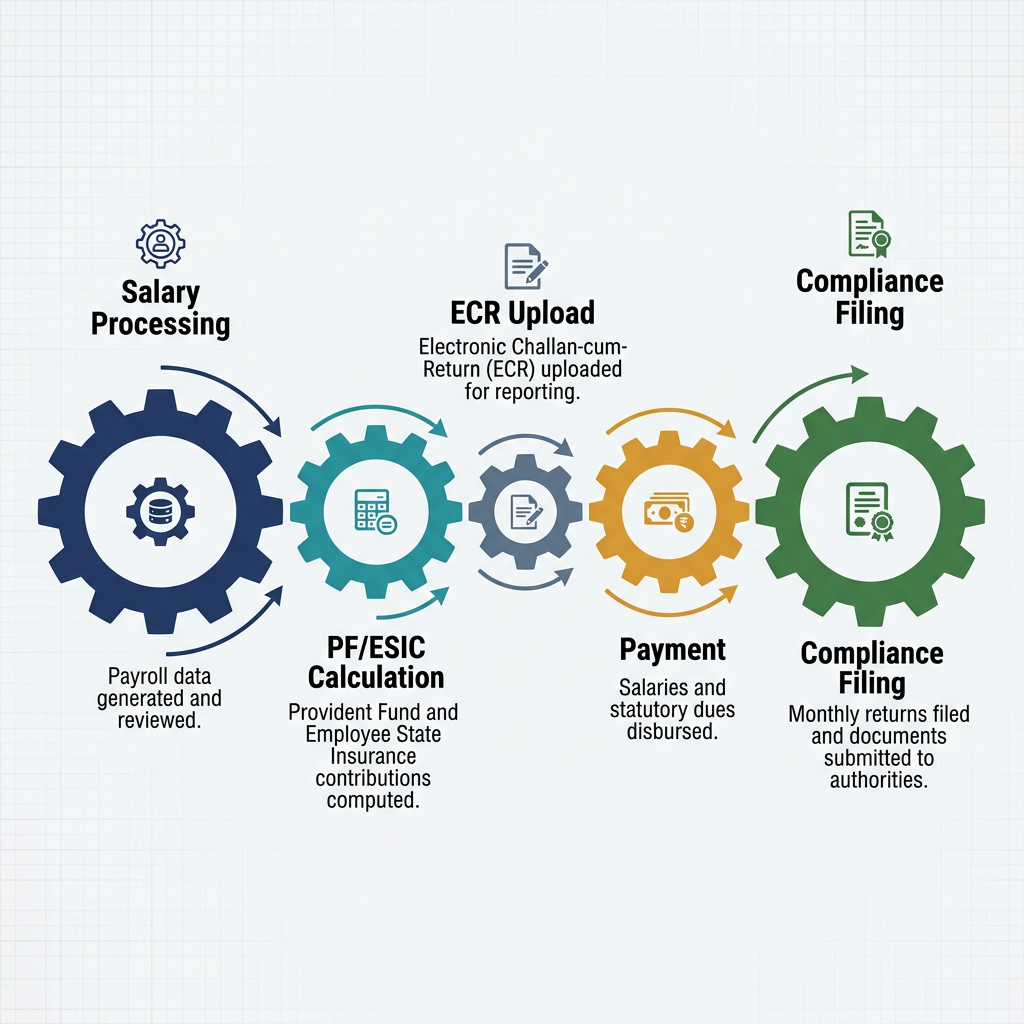
In practical terms, this means:
- Employee and employer PF contributions are calculated for the salary month
- The monthly challan is prepared
- The ECR file is uploaded on the EPFO portal
- Payment is made before the deadline
For most employers, the EPFO due date is the 15th of the following month. For example, PF for April salaries should typically be filed and paid by 15 May.
Why the 15th matters
The 15th is widely treated as the standard deadline for:
- PF return filing
- PF challan payment
- Monthly statutory reporting under EPF compliance
This timeline helps ensure employee accounts are updated on time and the employer remains compliant with labour law obligations.
PF Filing Process: Step-by-Step
Time needed: 5 minutes.
If your payroll team handles PF compliance, the monthly process usually looks like this:
- Calculate PF wages
Identify eligible PF wages for each employee based on payroll data.
- Compute contributions
Typically, both employer and employee contributions are calculated as per the applicable PF structure.
- Prepare the ECR file
The Electronic Challan-cum-Return (ECR) is the monthly file uploaded to EPFO.
- Validate employee details
Ensure UAN, name, PF number, wages, and contribution amounts are accurate.
- Upload the challan
Submit the ECR on the EPFO portal and generate the challan.
- Make payment before the due date
Complete payment through the authorised banking/payment channel on or before the PF challan due date.
- Preserve proof of filing
Keep challan copies, payment receipts, and reconciliation records for audit and inspection support.
PF/ESIC filing visualisation PF Return Filing vs PF Challan Filing
Many businesses use these terms interchangeably, but there is a practical difference.
PF return
This usually refers to the monthly statutory filing done through ECR, which reports employee-wise contribution details.
PF challan
This refers to the payment-side compliance, where the employer generates and pays the challan.
Why this matters
A company may upload data but fail to complete payment, or vice versa. From a compliance perspective, both steps must be completed accurately and on time.
Why the PF Filing Due Date Is So Important
Timely PF filing is essential for both legal and operational reasons.
1. Employee trust
Employees expect their PF deductions to reflect correctly in their UAN and passbook records. Delays can create trust issues.
2. Legal compliance
Late filing can attract EPF penalties and interest.
3. Financial discipline
Monthly compliance reduces the risk of year-end surprises and statutory backlogs.
4. Audit readiness
A clean monthly filing trail helps during internal audits, labour inspections, and due diligence.
5. Payroll accuracy
Regular filing ensures payroll, accounting, and statutory ledgers remain aligned.
What Records Should Employers Keep?
For strong provident fund compliance India practices, maintain the following:
- Monthly payroll register
- Employee PF contribution calculations
- ECR file copy
- Challan and payment confirmation
- UAN and employee master records
- Reconciliation between payroll and EPFO records
- Contractor compliance documents, if applicable
These records are useful for internal audits, inspections, and employee queries.
Common Mistakes
Even experienced payroll teams make avoidable PF compliance mistakes. Here are the most common ones:
1. Missing the internal cutoff date
Many employers depend on the 15th itself. A bank or portal delay can make the filing late.
2. Incorrect employee data
Wrong UAN, spelling mismatch, or outdated PF details can block or delay filing.
3. Payroll and ECR mismatch
If payroll registers and ECR data don’t match, reconciliation becomes difficult.
4. Delayed salary finalisation
If salary processing happens too late, the PF filing deadline may be missed.
5. Ignoring contractor liability
Principal employers often forget that contractor workforce documentation may also affect compliance exposure.
6. Underestimating penalties
Some companies treat PF filing delay as a minor lapse, but repeated delays can become expensive.
7. No monthly compliance review
Without a checklist, teams may overlook the PF return filing or payment confirmation.
Penalties for Late Filing
Late PF compliance can lead to financial and legal consequences.
1. Interest on delayed payment
Under the applicable EPF framework, delayed remittance generally attracts interest. The exact computation depends on the delay period and the applicable legal provisions.
2. Damages/penal charges
The EPFO may levy damages for delayed payment, subject to the relevant rules and assessment process.
3. Compliance exposure
Repeated delays may lead to:
- Notices from authorities
- Inspection risk
- Employee complaints
- Adverse findings in due diligence or audit
Practical takeaway
Even one missed PF challan due date can create a chain of compliance issues, especially for companies with multiple payroll cycles or high employee turnover.
Note: Since statutory treatment can vary based on facts and the applicable provisions, employers should review the latest EPFO rules or seek compliance advice for specific cases.
Best Practices for Compliance
If you want to stay ahead of monthly statutory requirements, build PF compliance into your payroll process.
1. Set an internal deadline before the 15th
A good practice is to complete payroll and approvals by the 10th or 12th.
2. Use a monthly compliance checklist
Track:
- Salary finalisation
- PF calculation
- ECR generation
- Payment approval
- Receipt download
- Record storage
3. Reconcile payroll and EPFO data every month
This helps identify errors before they become recurring issues.
4. Maintain employee master data carefully
Keep UAN, Aadhaar-linked details, and salary components updated.
5. Assign clear ownership
One person should own payroll compliance, while another should review and sign off.
6. Monitor vendor compliance
If payroll is outsourced, ensure your service provider follows the EPFO due date and preserves proof.
7. Review changes in wage structure
Any changes in CTC, allowances, or employee categories can affect PF calculations.
8. Build compliance into onboarding and exit processes
New joiners and exits should be updated accurately to avoid reporting issues.
9. Keep a buffer for payment failures
Banking issues, portal errors, or data validation problems can happen. A buffer reduces risk.
10. Seek expert support if your team is stretched
For growing businesses, professional support can reduce errors and improve compliance consistency.
FAQs:
What is the PF filing due date in India?For most employers, the PF filing due date is the 15th of every month for the previous month’s contributions.
Is the PF challan due date the same as the EPFO due date?In practice, yes. Employers usually refer to the 15th as both the PF challan due date and the EPFO due date for monthly payment and filing.
What happens if PF is filed late?Late filing may result in interest, damages, notices, and compliance complications under EPF rules.
Does monthly PF filing apply to startups?Yes, if the startup is covered under EPF law or has voluntarily registered, it must follow monthly PF filing requirements.
Is PF return filing different from payment?Yes. PF return filing generally refers to submitting the ECR data, while payment refers to remitting the challan amount. Both are required for compliance.
The PF filing due date is not just a calendar reminder, it is a critical part of EPF compliance and overall statutory compliance obligations. For employers, the rule is simple: complete your monthly PF filing and payment on or before the 15th of every month to avoid interest, penalties, and employee dissatisfaction.
A disciplined PF process protects your workforce, strengthens payroll governance, and reduces compliance risk. If your team needs support with PF return filing, payroll controls, labour law compliance services, HR outsourcing, or broader statutory compliance support, Serve HR can help you build a reliable compliance system that works month after month.